

Let's be honest: nobody talks enough about what happens after the baby arrives. Everyone's focused on the pregnancy, the delivery, the nursery. But then you're home, you're exhausted, your body feels completely foreign, and somehow the conversation shifts to "getting your body back."
Here's what we tell every new mom who walks into Hideout Fitness: you're not trying to get your body back. You're building a stronger one. And the way you do that after pregnancy matters more than most people realize.
Your Body After Pregnancy Is Not the Same. Here's What Actually Changes
Nine months of pregnancy change how everything works. Your deep core muscles stretched and separated to make room for your baby. Your pelvic floor absorbed enormous pressure for the better part of a year. And the hormone relaxin, which loosens your ligaments during pregnancy, can stick around for months after delivery, especially if you're breastfeeding, leaving your joints more vulnerable than you'd expect.
Then there's diastasis recti, a separation of the abdominal muscles that most pregnant women experience to some degree. It's one of the most common and most misunderstood postpartum conditions out there. Jump back into sit-ups or heavy compound lifts without addressing it, and you can actually make it worse. A trainer who knows postnatal physiology knows how to find it, work around it, and help you heal it.
Resistance training after pregnancy can be incredibly effective, but it requires the right exercise selection, the right modifications, and a real understanding of what the postpartum body needs. That's not something a generic gym program gives you.
Why Going It Alone Usually Backfires for Postpartum Fitness
Most workout programs out there weren't built with postpartum women in mind. They don't account for diastasis recti, pelvic floor dysfunction, or the hormonal shifts that make your body behave differently than it did before. So new moms follow them anyway, skip the foundational work their body desperately needs, and end up hurt, frustrated, or both.
And then there's the consistency problem. Most women don't return to their pre-pregnancy activity levels after having a baby: fatigue, time constraints, and not knowing where to start are the biggest reasons.
A trainer removes that guesswork completely. If staying active during a busy season feels like an uphill battle, our guide on how to stick with fitness when your schedule gets busy is a great place to start.
Meet Orange County's Postnatal Personal Training Specialists
At Hideout Fitness in Irvine, Newport Beach, Costa Mesa, and Tustin, two of our coaches specialize specifically in postnatal training. They've worked with dozens of moms throughout Orange County, and they know exactly how to build programs that meet new moms where they actually are, not where they were before pregnancy.
Coach Chay: Women's Fitness Specialist
Chay has a degree in Kinesiology and deep credentials in strength, conditioning, and women's fitness. He takes a science-backed approach to postnatal training, building programs that are safe, progressive, and actually make sense for where you are in recovery.
"Strength training is about building what you need to get through labor and recover after. I work with moms across Orange County, and the ones who stick with it always feel more prepared, and they recover faster." - Coach Chay
Coach Emily: Prenatal/Postpartum Certified
Emily specializes in pre and postnatal training with serious experience in weightlifting and strength development. She's passionate, encouraging, and genuinely invested in helping new moms build confidence that lasts long after the postpartum period ends.
"Your body can do way more than you think. I've trained dozens of moms in our community, and every single one who strength trains has easier labors and faster recoveries. That confidence doesn't go away." - Coach Emily
What Postnatal Personal Training at Hideout Fitness Actually Looks Like
Here's what you can expect when you work with Coach Chay or Coach Emily:
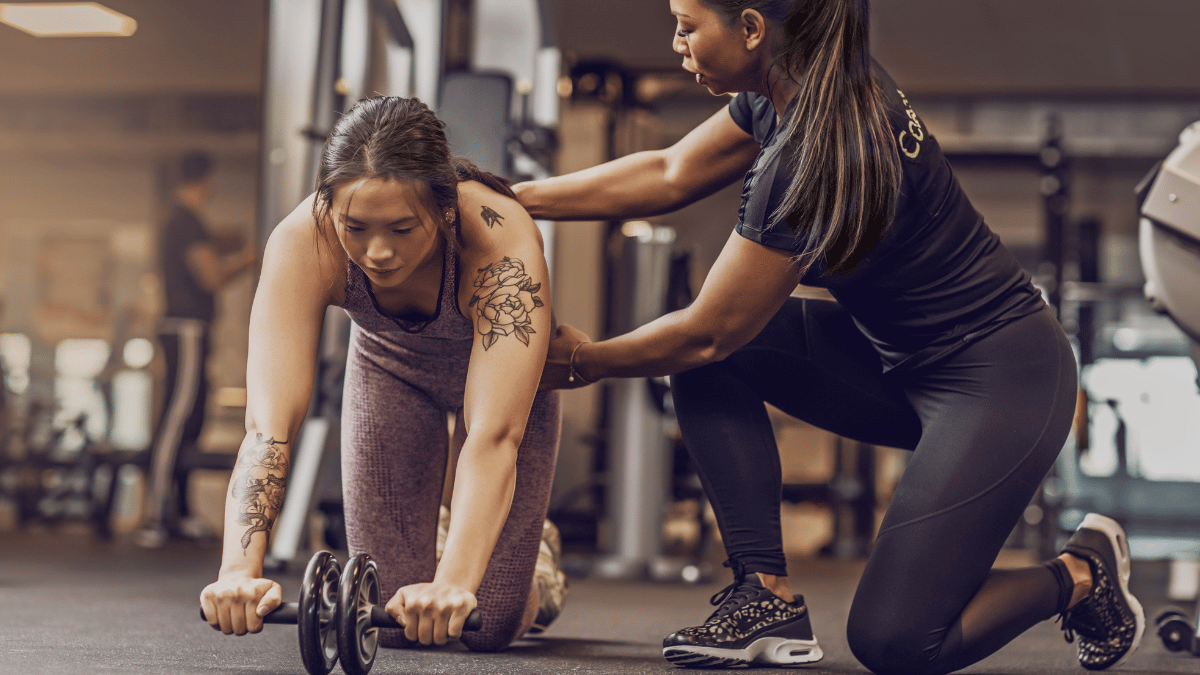
- A real assessment before anything else: Before a single weight gets picked up, your trainer looks at how you move: your posture, your core activation, your pelvic floor function, and any compensation patterns that snuck in during pregnancy. Everything builds from there.
- Core reconnection first: Your deepest core layer, the transverse abdominis, gets stretched out during pregnancy and doesn't just bounce back on its own. Rebuilding that foundation before adding load is what makes everything else work better and hurt less.
- A program that actually fits you: Your trainer builds your plan around your delivery type, your current pelvic floor function, any diastasis recti present, and how your recovery is actually going. Not a template; a real program designed for you.
The Real Benefits of Postnatal Weight Training With a Trainer
- You get strong again, faster: When the foundation is right, everything else moves quicker. You're fixing problems.
- Your posture improves: Between nursing, carrying, and bending over a crib a hundred times a day, new moms take a beating posture-wise. Strength training is one of the most effective ways to counteract the postural damage pregnancy and new motherhood put on your body. We go deep on this in our piece on why strength training changes everything.
- Your mental health gets better: This one's big. Research shows that supervised exercise consistently outperforms unsupervised exercise when it comes to reducing postpartum depression symptoms. Having a trainer is better for your head too.
- Your core and pelvic floor actually heal: This is the piece most programs skip entirely. Getting this right early means fewer problems down the road: less back pain, better bladder control, and a core that actually works.
- You have more energy: Postpartum exercise improves aerobic fitness, insulin sensitivity, and psychological well-being. When you're running on broken sleep and running after a newborn, that energy boost is everything. And once your foundation is solid, our guide on the best workouts for belly fat is a great next step.
When Can New Moms Start Weight Training After Giving Birth?
Not at six weeks. Or at least, not necessarily. Every recovery is different. Vaginal deliveries without complications can often handle gentle movement within days. C-sections are major abdominal surgery, and your program needs to reflect that timeline.
The six-week checkup is a green light for basic healing, not a green light for squatting heavy. Coach Chay and Coach Emily both know the difference, and they build your program around where your body actually is. Working with a postnatal-certified trainer (always in coordination with your OB-GYN) is the safest and most effective way to return to training after birth.
Already pregnant and thinking ahead? Our prenatal strength training guide walks you through exactly how to train safely before delivery, which makes coming back postpartum a whole lot smoother.
Train With Orange County's Postnatal Fitness Experts at Hideout Fitness
You don't need a "get your body back" plan. You need a program built for the body you have right now, by coaches who actually understand it.
Coach Chay and Coach Emily are here for exactly that. Come find us in Irvine, Newport Beach, Costa Mesa, or Tustin, and let's build something that lasts.
You grew a human (and grew as a human). Let's get you strong again.

.jpg)
.jpg)






.png)













.png)


.png)




.png)
.png)
.png)


